
Choosing the appropriate lubricant

Decision guide: Choosing between INSTILLAGEL® and JELIDO®1-3

FeatureJELIDOINSTILLAGEL
LubricationYesYes
Local anaesthetic (2% lidocaine)YesYes
Contains antiseptic (0.05% chlorhexidine)NoYes

The selection of an appropriate lubricant also depends on its intended use as different products are indicated for different clinical applications.1,2

JELIDO

JELIDO® (lidocaine hydrochloride jelly) is indicated for:1

  • Surface anaesthesia and lubrication for:
    • The male and female urethra during cystoscopy, catheterization, exploration by sound, and other endourethral operations
    • Nasal and pharyngeal cavities in endoscopic procedures such as gastroscopy and bronchoscopy
    • Proctoscopy and rectoscopy
    • Tracheal intubation
  • Symptomatic treatment of pain in connection with cystitis and urethritis

INSTILLAGEL

INSTILLAGEL® (lidocaine and chlorhexidine gel) is indicated for surface anaesthesia, lubrication, and antisepsis for:2

  • The male and female urethra during cystoscopy
  • Catheterization
  • Exploration by sound and other endourethral operations

Comparing key ingredients1,2

Both JELIDO® and INSTILLAGEL® provide:1,2

Protective, uniform LUBRICATION

May reduce the risk of injury during instrumentation4

Rapid†, lasting‡, ANAESTHETIC action

  • Contain 2% lidocaine hydrochloride
  • Anaesthetize within 5 to 10 minutes and last approximately 20 to 30 minutes

INSTILLAGEL® offers the added benefit of:2

ANTISEPTIC properties

  • Contains 0.05% chlorhexidine gluconate
  • Effective protection against a wide spectrum of microorganisms
  • Especially useful for urological interventions

Analgesic properties of JELIDO® and INSTILLAGEL®1,2

Lidocaine is an amide-type local anaesthetic. In both JELIDO® and INSTILLAGEL®, it is used at a 2% concentration.1,2

Anaesthesia is typically achieved within 5 minutes, depending on the site of application, and lasts for approximately 20 to 30 minutes.1,2

May reduce risk of endourethral injury because the anaesthetic action reduces pain, which may subsequently reduce patient movement such as tensing or flinching4,5

Both JELIDO® and INSTILLAGEL® feature the same FARCO®* syringe design1,2,6

Innovative UROSAFETIP®1,2,6

The innovative UROSAFETIP® design helps reduce the risk of injury and supports patient comfort

Easy to use, pre-assembled, prefilled, sterile syringe1,2,6

JELIDO® and INSTILLAGEL® offer an easy-to-use, one-handed, prefilled syringe

Manufactured in GMP‑compliant facilities, JELIDO® and INSTILLAGEL® deliver consistent product quality you can trust.

Optimized packaging material for more sustainability6
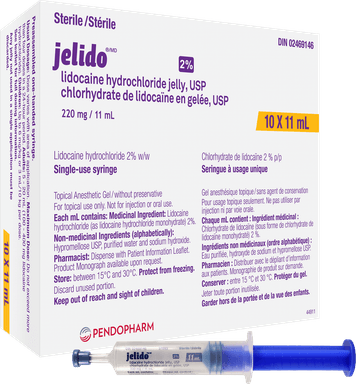
JELIDO® 2% lidocaine hydrochloride jelly, 10 × 11 mL carton

Illustration of packaging dimensions for 10 syringes

Schematic illustration of a 10-syringe carton. The illustration depicts the underside (bottom view) of the carton. The grey rectangles represent individual syringe packages, while the surrounding box represents the outer carton containing all 10 syringes.

JELIDO®

STORAGE

Reduced packaging = smaller footprint on shelves


WASTE

Less packaging = less waste


TIME

Removal from package is simple and quick

Learn how the prefilled FARCO®* syringe performs

Want to know more aboutINSTILLAGEL

Learn more

JELIDO® (lidocaine hydrochloride jelly) is indicated for:1

  • Surface anaesthesia and lubrication for:
    • The male and female urethra during cystoscopy, catheterization, exploration by sound, and other endourethral operations;
    • Nasal and pharyngeal cavities in endoscopic procedures such as gastroscopy and bronchoscopy;
    • Proctoscopy and rectoscopy;
    • Tracheal intubation.
  • Symptomatic treatment of pain in connection with cystitis and urethritis

for additional safety information and for a link to the Product Monograph, which discusses:1

  • Contraindications in patients with: a hypersensitivity to this drug or any ingredient in the formulation; a known history of hypersensitivity to amide-type local anaesthetics or other formulation components; congenital or idiopathic methemoglobinemia; a need for treatment with methemoglobin-inducing agents (e.g., sulfonamides) in infants ≤ 12 months of age; or, glucose-6-phosphate dehydrogenase deficiency
  • Most serious warnings and precautions regarding: adherence to the recommended dosage; and use in children and infants (< 3 months of age)
  • Other relevant warnings and precautions regarding: use of the lowest effective dose; avoiding contact with eyes; familial malignant hyperthermia; increased plasma concentrations in patients under general anaesthesia; use in unparalyzed patients; endotracheal tube lubrication; risk of aspiration; unintentional biting trauma; impairment of locomotion or alertness; caution when driving and operating machinery; and use in patients with porphyria. Use with caution in patients with: sepsis; traumatized mucosa at the application site; epilepsy; severe shock; bradycardia; impaired cardiovascular function; hepatic disease or impaired renal function; or known drug sensitivities. Reduced doses should be given in debilitated patients, acutely ill patients, and patients with sepsis. Care should be taken during early pregnancy.
  • Conditions of clinical use, adverse reactions, drug interactions, and dosing instructions

INSTILLAGEL® (lidocaine and chlorhexidine gel) is indicated for surface anaesthesia, lubrication, and antisepsis for:2

  • The male and female urethra during cystoscopy
  • Catheterization
  • Exploration by sound and other endourethral operations

Click here for additional safety information and for a link to the Prescribing Information, which discusses:

  • Contraindications in children < 2 years of age and in patients with a known or suspected hypersensitivity to this drug or any component of the formulation
  • Most serious warnings and precautions regarding use in urethra only (not for parenteral administration) and immediate systemic hypersensitivity reactions
  • Other relevant warnings and precautions regarding use of the lowest effective dose; avoiding contact with eyes and middle ear; familial malignant hyperthermia; carcinogenesis and mutagenesis; excessive hypotensive response; use during early pregnancy (first trimester); and dose reduction in children, debilitated patients, acutely ill patients, and patients with sepsis. Use with caution in patients with severe shock; sepsis and/or traumatized mucosa at the application site; epilepsy; impaired cardiac conduction; bradycardia; impaired cardiovascular function; impaired hepatic or renal function; and known drug sensitivities.
  • Conditions of clinical use, adverse reactions, drug interactions, and dosing instructions

d: depth; h: height; w: width
†Anaesthesia is achieved within 5 minutes, depending on the area of application.
‡Duration of anaesthesia is approximately 20 to 30 minutes.

References: 1. JELIDO® Product Monograph. PENDOPHARM®, Division of Pharmascience Inc. February 19, 2026. 2. INSTILLAGEL® Prescribing Information. PENDOPHARM®, Division of Pharmascience Inc. February 19, 2025. 3. Wilson M. Catheter lubrication and fixation: interventions. Br J Nurs. 2013 May 23-Jun 12;22(10):566, 568-569. 4. Sperling H, Lümmen G, Rübben H. The use of lubricants in urology. Indications and results. Urologe. [A] 2005;44(6):662-666. 5. Muctar S. [The importance of a lubricant in transurethral interventions]. Urologe. [B] 1991;31:153-155. 6. Data on file. PENDOPHARM®, Division of Pharmascience Inc.

PENDOPHARM

JELIDO and UROSAFETIP are registered trademarks of Finchley Research & Development Inc., used under license. INSTILLAGEL is a registered trademark of FARCO-PHARMA GmbH, used under license. PENDOPHARM and its logo are registered trademarks of Finchley Research & Development Inc., used under license.

*Registered trademarks are the property of their respective owners.

© 2026 PENDOPHARM®. All rights reserved.

Publication date: 29-10-2026

Contact us

For any questions about our products or further information about our company, please do not hesitate to contact us.

JELIDO® and INSTILLAGEL® are available at select specialty pharmacies and by special order at most pharmacy outlets.

6111 Royalmount AvenueMontreal (Quebec)H4P 2T4, CanadaTelephone+1 (514) 340-5045Fax+1 (866) 926-7654 or +1 (514) 733-9684

MED INFO

Toll-free Telephone: +1 (888) 550-6060
Fax: +1 (514) 340-0164
E-mail: medinfo@pharmascience.com

PHARMACOVIGILANCE:

By Telephone: +1 (888) 550-6060
By Fax: +1 (866) 551-1939
By E-mail: adr@pharmascience.com

For Medical and Scientific Information Services, Adverse Event Report, and Customer Service, please visit our website at https://pendopharm.com/contact/.

JELIDO® important safety information

Indications and clinical use:

JELIDO® (lidocaine hydrochloride jelly) is indicated for:

  • Surface anaesthesia and lubrication for:
    • The male and female urethra during cystoscopy, catheterization, exploration by sound, and other endourethral operations
    • Nasal and pharyngeal cavities in endoscopic procedures such as gastroscopy and bronchoscopy
    • Proctoscopy and rectoscopy
    • Tracheal intubation
  • Symptomatic treatment of pain in connection with cystitis and urethritis

Pediatrics (2–18 years of age): Children should be given reduced doses commensurate with their age, weight, and physical condition.

Pediatrics (< 2 years of age): Lidocaine should be used with caution in children younger than two years of age as there are insufficient data to support the safety and efficacy of this product in this patient population at this time.

Geriatrics (> 65 years of age): Elderly patients should be given reduced doses commensurate with their age and physical condition.

Contraindications:

  • Patients who are hypersensitive to this drug or to any ingredient in the formulation, including any non-medicinal ingredient, or any component of the container
  • Patients with a known history of hypersensitivity to local anaesthetics of the amide type or to other components in the formulation
  • Patients with congenital or idiopathic methemoglobinemia
  • Infants ≤ 12 months of age who require treatment with methemoglobin-inducing agents (e.g., sulfonamides)
  • Patients with glucose-6-phosphate dehydrogenase deficiency, which makes them more susceptible to drug-induced methemoglobinemia

Most serious warnings and precautions:

  • PATIENTS SHOULD BE INSTRUCTED TO STRICTLY ADHERE TO THE RECOMMENDED DOSAGE: EXCESSIVE DOSAGE, OR SHORT INTERVALS BETWEEN DOSES, CAN RESULT IN HIGH PLASMA LEVELS OF LIDOCAINE OR ITS METABOLITES AND SERIOUS, AS WELL AS LIFE-THREATENING, ADVERSE EFFECTS, including methemoglobinemia.
  • Use in children and infants (< 3 months): Ensure the caregiver understands to limit the dose and area of application and to prevent accidental ingestion. Children should be closely observed during and after use of lidocaine as they are at greater risk than adults for serious adverse events (e.g., methemoglobinemia).

Other relevant warnings and precautions:

  • Lowest effective dose should be used
  • Avoid contact with eyes
  • Potential triggering agent for familial malignant hyperthermia
  • In patients under general anaesthesia who are paralyzed, higher plasma concentrations may occur than in spontaneously breathing patients
    • Unparalyzed patients are more likely to swallow a large proportion of the dose, which then undergoes considerable first-pass hepatic metabolism following absorption from the gut
  • Endotracheal tube lubrication
    • Avoid introduction of the jelly into the lumen of the tube
    • Do not use to lubricate the endotracheal stylettes
  • Topical anaesthetics used in the mouth may enhance the danger of aspiration
  • Numbness of the tongue or buccal region may enhance unintentional biting trauma
  • May temporarily impair locomotion or alertness
  • Use with caution in patients with:
    • Sepsis
    • Traumatized mucosa at the area of application
    • Epilepsy
    • Severe shock
    • Bradycardia
    • Impaired cardiovascular function
    • Hepatic disease or impaired renal function
    • Known drug sensitivities
  • Exercise caution when driving and operating machinery
  • Exercise caution with use in all porphyric patients
  • Reduced doses should be given in debilitated patients, acutely ill patients, and patients with sepsis
  • Care should be taken during early pregnancy

For more information:

Consult the Product Monograph for important information relating to adverse events, drug interactions, and dosing that has not been discussed in this piece. The Product Monograph is also available by calling 1-888-550-6060.